

Books
-
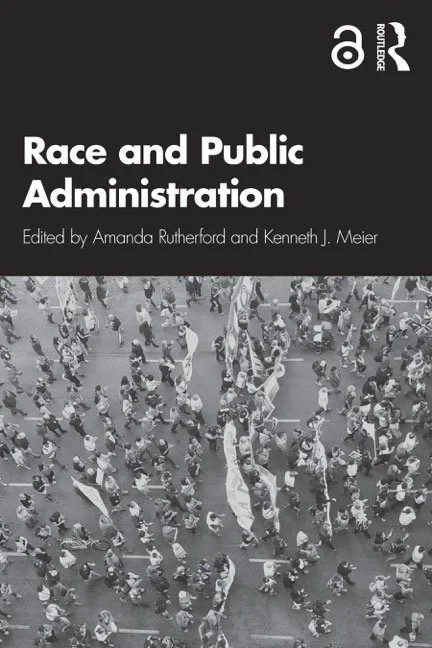
Race and Public Administration
Race and Public Administration confronts how race shapes policy across the United States and why existing research often fails to give practitioners usable guidance. The book argues that scholarship should directly inform practice to advance equity rather than avoid the issue. It provides an accessible synthesis of current and emerging research on race, policy, and administration for public servants, contractors, and nonprofit leaders.
-
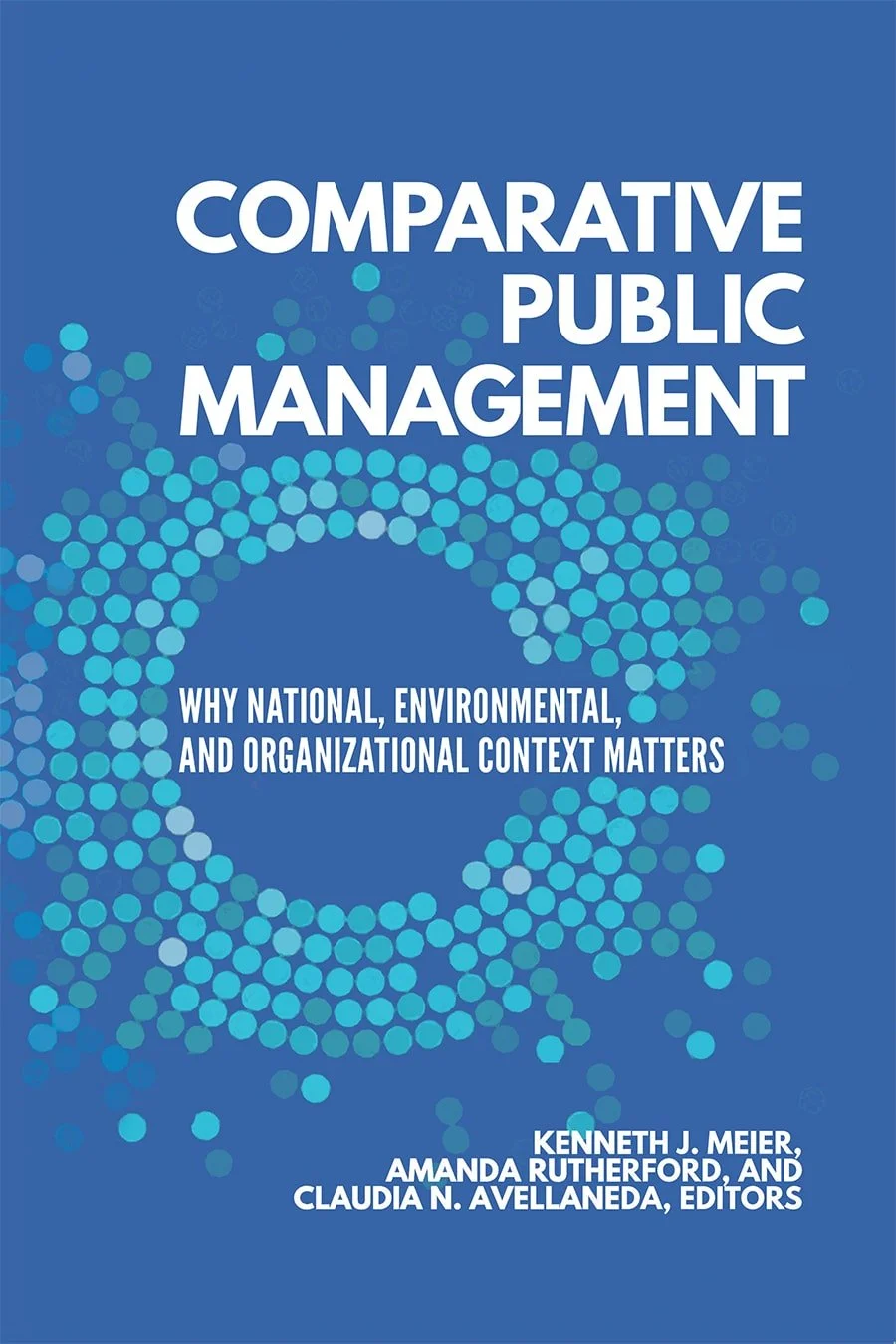
Comparative Public Management
Cross-national evidence from the United States, United Kingdom, and Netherlands demonstrates that management practices succeed or fail based on political, environmental, and organizational context. Managerial networking, for example, operates differently across these systems. A contextual framework clarifies how public managers can select actions that actually work within their institutional setting, moving the field toward a more general comparative model.
-

The Politics of African-American Education
Race influences policy creation and implementation across the United States, yet most research offers little practical guidance for public-sector decision makers. A clear link is drawn between scholarship and practice to confront equity issues directly rather than sidestep them. Current and emerging research on race and policy is synthesized for use by public servants, contractors, and nonprofit leaders seeking to apply evidence-based approaches to equity in administration.

Peer-Reviewed Publications
*Denotes student co-author at time of writing
-
Hanging in the Balance: Assessing Goal Prioritization Among Street-Level Bureaucrats.
Rutherford, Amanda and Shaun Khurana*. Forthcoming. Public Performance & Management Review.
-
Revisiting the importance of representation and glass cliffs in predicting the selection of women to lead public sector organizations.
Rutherford, Amanda and Thomas Rabovsky. Forthcoming. International Public Management Journal.
-
The Political Calculus of Chief Executive Officers: The Influence of Policymakers and Governing Boards on Bureaucratic Turnover and Vacancy.
Rutherford, Amanda, Thomas Rabovsky, and Karl Santiago*. Forthcoming. Public Performance & Management Review.
-
Institutional Pressures, discretion, and bureaucratic responses to clients: An Experimental Study of School-Based Law Enforcement Officers.
Rutherford, Amanda and Nathan Favero. Forthcoming. International Public Management Journal.
-
Bad Times Keep Us Together: Policy Priorities and Economic Shocks.
Lipsmeyer, Christine, Andrew Philips, Amanda Rutherford, and Guy D. Whitten. 2024. Social Science Quarterly 105(4): 934-947.
-
The Limits of Framing Effects: Citizen Perceptions of Councilor Compensation.
Rutherford, Amanda and Cullen Merritt. 2024. Local Government Studies 50(1): 87-108.
-
What Explains Variation in Representation in the Public Sector? Predicting the Presence of Female Officers in US College Police Departments.
Rutherford, Amanda and Emily Mee*. 2023. Public Administration Review 83(4): 895-910.
-
Vacancies among appointees in U.S. federal agencies: Implications for employee attitudes and intentions.
Rutherford, Amanda and Taha Hameduddin*. 2023. Governance 36(4):1247-1269.
-
Predicting executive vacancies: An organizational approach.
Bello-Gómez, Ricardo A.* and Amanda Rutherford. 2023. Public Administration 101(1): 236-270.
-
Job Vacancy and Organizational Performance: Are Senior Managers or Street-Level Bureaucrats Missed Most?
Wightman, Breck*, Sergio Fernandez, and Amanda Rutherford. 2022. Public Administration Review 82(4): 660-670.
-
Inside the Push for Good Governance: Institutional Predictors of Administrative Transparency in Public Organizations.
Rutherford, Amanda and Breck Wightman*. 2021. American Review of Public Administration 51(8): 590-604.
-
Compared to whom? Social and historical reference points and performance appraisals by managers, students, and the general public.
Rutherford, Amanda, Thomas Rabovsky, and Megan Darnley*. 2021. Journal of Behavioral Public Administration 4(1
-
Completion at the Expense of Access? The Relationship Between Performance-Funding Policies and Access to Public 4-Year Universities.
Rutherford, Amanda and Denisa Gándara. 2020. Educational Researcher 49(5): 321-334.
-
A Command to Estimate and Interpret Models of Dynamic Compositional Dependent Variables: New Features for Dynsimpie.
Jung, Yoo Sun*, Flavio D. S. Souza*, Andrew Q. Philips, Amanda Rutherford, and Guy D. Whitten. 2020. Stata Journal 20(3):584-603.
-
Organizational Turnaround: Moving Beyond One-Size-Fits-All Solutions.
Rutherford, Amanda and Nathan Favero. 2020. International Public Management Journal 23(3): 315-335.
-
Will the Tide Lift All Boats? Examining the Equity Effects of Performance Funding Policies in U.S. Higher Education.
Favero, Nathan and Amanda Rutherford. 2020. Research in Higher Education 61(1): 1-25.
-
Tipping the Scales: The Causes and Consequences of Administrative Spending.
Darnley, Megan*, Amanda Rutherford, and Thomas Rabovsky. 2019. Public Administration 97(2): 567-482.
-
Shifting Administrative Intensity and Employee Composition: Cutback Management in Education.
Rutherford, Amanda and Joris van der Voet. 2019. American Review of Public Administration 49(6): 704-719.
-
Managing the Gaps: How Performance Gaps Shape Managerial Decision Making.
Zhu, Ling and Amanda Rutherford. 2019. Public Performance & Management Review 42(5): 1029-1061.
-
Comparing Dynamic Pies: A Strategy for Modeling Compositional Variables in Time and Space.
Lipsmeyer, Christine, Andrew Philips, Amanda Rutherford, and Guy D. Whitten. 2019. Political Science Research and Methods 7(3): 523-540.
-
Understanding Vacancy Time: A Theoretical Framework Informed by Cross-Sector Comparison.
Rutherford, Amanda, Jeryl Mumpower, Ricardo A. Bello-Gómez*, and Marlisa Griffin*. 2019. Perspectives on Public Management and Governance 2(1): 3-20.
-
The Effects of Premiums for Underserved Populations in Performance Funding Policies for Higher Education.
Gándara, Denisa and Amanda Rutherford. 2018. Research in Higher Education 59(6): 681-703.
-
Does the Motivation for Market-Based Reform Matter: The Case of Responsibility Centered Management.
Rutherford, Amanda and Thomas Rabovsky. 2018. Public Administration Review 78(4): 626-639.
-
Top Management Turnover: The Role of Governing Board Structures.
Rutherford, Amanda and Jon Lozano*. 2018. Public Administration Review 78(1): 104-115.
-
Types of Coproduction and Differential Effects on Organizational Performance: Evidence from the New York City School System.
Zambrano-Gutiérrez, Julio César*, Amanda Rutherford, and Sean Nicholson-Crotty. 2017. Public Administration 95(3): 776-790.
-
The Role of Managerial Fit in Determining Organizational Performance: An Empirical Assessment of Presidents in U.S. Higher Education.
Rutherford, Amanda. 2017. American Review of Public Administration 47(7): 764-778
-
The Effect of Top Management Team Heterogeneity on Performance in Institutions of Higher Education.
Rutherford, Amanda. 2016. Public Performance and Management Review 40(1): 119-144.
-
Dynsimpie: A Program to Examine Dynamic Compositional Dependent Variables.
Philips, Andrew Q., Amanda Rutherford, and Guy D. Whitten. 2016. Stata Journal 16(3): 662-677.
-
The Politics of Higher Education: University President Ideology and External Networking.
Rabovsky, Thomas and Amanda Rutherford. 2016. Public Administration Review 76(5): 754-777.
-
Goal Ambiguity in Financial Aid and the Contingency of Organizational Mission.
Rutherford, Amanda. 2016. Journal of Student Financial Aid 46(2): 2-24.
-
Voting Rights for Whom?: Examining the Effects of the Voting Rights Acts on Latino Political Incorporation.
Marschall, Melissa and Amanda Rutherford. 2016. American Journal of Political Science 60(3): 590-606.
-
Reexamining Causes and Consequences: Does Administrative Intensity Matter for Organizational Performance?
Rutherford, Amanda. 2016. International Public Management Journal 19(3): 342-369.
-
Dynamic Pie: A Strategy for Modeling Trade-Offs in Compositional Variables over Time.
Philips, Andrew, Amanda Rutherford, and Guy D. Whitten. 2016. American Journal of Political Science 60(1): 268-283.
-
DYNSIMPIE: Stata module to examine dynamic compositional dependent variables.
Philips, Andrew, Amanda Rutherford, and Guy D. Whitten. 2015.
-
For Better or for Worse: Organizational Turnaround in New York City Schools.
Favero, Nathan and Amanda Rutherford. 2016. Public Management Review 18(3): 437-455.
-
The Dynamic Battle for Pieces of the Pie—Modeling Party Support in Multi-Party Nations.
Philips, Andrew, Amanda Rutherford, and Guy D. Whitten. 2015. Electoral Studies 39: 264-274.
-
Conquering the ‘Lumbering Dinosaur’: Graduate Student Experiences at Political Science Conferences.
Rutherford, Amanda. 2015. PS: Political Science & Politics 48(2): 324-327.
-
Management Decisions in a Performance Driven System: Theory and Empirical Tests in Higher Education.
Rutherford, Amanda and Kenneth J. Meier. 2015. Public Administration 93(1): 17-33.
-
Evaluating Impacts of Performance Funding Policies on Student Outcomes.
Rutherford, Amanda and Thomas Rabovsky. 2014. The Annals of the American Academy of Political and Social Science 655(1): 185-208.
-
Partisanship, Structure, and Representation: The Puzzle of African American Education Politics.
Meier, Kenneth J. and Amanda Rutherford. 2014. American Political Science Review 108(2): 265-280.
-
Organizational Turnaround and Educational Performance: The Impact of Performance-Based Monitoring Analysis Systems.
Rutherford, Amanda. 2014. The American Review of Public Administration 44(4): 440-458.